




EP LOCOMOTIVE ACADEMY EDUCATION CORNER
Dear Families for El Paso Locomotive FC’s Youth Soccer Club,
This is the first edition of our Club’s newest initiative, what we will call Education Corner moving forward. The idea is to provide you all, families, players, siblings, and everybody involved in the life of our Academy some multimedia content that could widen your horizon, help your understanding, and provide new perspectives when it comes to soccer player development, team sports environments, child development, pedagogy, and other topics that we come across in our daily professional lives and youth soccer professionals.
This is a very simple proposal to you all: read the articles, listen to the podcasts, and watch the videos because we believe they are beneficial. It is that simple. No need to respond to the content (even though, we would love feedback, always!) as we just want to direct you guys towards a path that we think is positive when it comes to running our Club.
The Education Corner will not be an everyday or every-week initiative. The goal is to share when we feel that there is something to share. With that being said, I will try to share content with you at least once a month.
SIXTEENTH EDITION
Understanding the ECNL Regional League – Mountain Division in El Paso
As the girls’ soccer landscape in El Paso continues to evolve, our goal is to provide clarity for families—both within our club and across the broader community—during an important period of preparation for the upcoming season and tryout window. This communication is intended to help bridge understanding and outline what the introduction of the ECNL Regional League Mountain Division represents for our players and the El Paso soccer community as a whole.
The ECNL Regional League operates under the national ECNL umbrella and is designed to provide a structured pathway for player development, competition, and exposure. All ECNL Regional League platforms—including the Mountain Division—are overseen by ECNL leadership and require participating clubs to meet established standards related to club structure, coaching, and overall operations in alignment with ECNL guidelines.
Historically, the South Texas Champions League (STXCL) has been the ECNL Regional League platform most closely associated with El Paso-based teams. However, it has not functioned as a true regional league for the El Paso market. The league is primarily centered in South Texas, with most competition taking place in cities such as San Antonio and surrounding areas. This has required El Paso teams to travel consistently for all league matches, both home and away. As a result, while ECNL Regional League participation has existed for El Paso clubs, league competition has not been hosted within the city.
It is also important for families to understand how ECNL Regional League platforms can function differently across regions. In South Texas-based leagues such as STXCL, many larger clubs field multiple teams across the ECNL ecosystem, including participation in ECNL Girls and other ECNL Regional League conferences, such as the Texas Conference. Within these club structures, teams competing in STXCL often represent additional levels within a broader developmental pathway. For clubs that operate at the ECNL Girls level, STXCL teams may serve as a third level of competition. For clubs without ECNL Girls but with teams competing in other ECNL Regional League conferences, STXCL teams may represent a secondary level within their structure.
Clubs such as FC Westlake, Lonestar SC, Sting Soccer Club, RISE Soccer Club, Albion Hurricanes FC, Challenge SC, and Classic Elite Soccer Academy exemplify organizations that operate multiple teams across these platforms, structuring their rosters to support player development at varying competitive levels.
With El Paso Locomotive FC now competing in the ECNL Regional League Mountain Division, El Paso will begin to regularly host many of the top clubs and teams from across the broader region. This represents a meaningful and long-awaited shift, as high-level ECNL Regional League competition will now take place within our city on a consistent annual basis, rather than requiring travel to access this level of play.
This advancement brings significant benefits to families and players. It reduces the overall travel burden while maintaining a high standard of competition, increases access to meaningful matches against strong regional opponents, and strengthens El Paso’s connection within the ECNL pathway.
It is also important for families to recognize that, within the girls’ landscape in this region, the ECNL Regional League currently represents the highest level of ECNL competition available locally, as there is no ECNL national league platform operating within the Mountain Division for girls at this time.
While all ECNL Regional League platforms operate under the same national structure, the Mountain Division offers broader geographic reach and more consistent access to high-level regional competition, with many participating clubs fielding their top Regional League teams within this platform.
For El Paso families, this translates to more high-level matches, greater visibility, and expanded opportunities for player development—while significantly reducing the need for extensive travel to access top competition.
This marks a significant step forward for the growth of the game in our city and reflects our continued commitment to building a stronger, more accessible, and clearly defined pathway for our players within the ECNL framework.
Todo sobre ECNL Regional League – Mountain Division en El Paso
A medida que el panorama del fútbol femenil en El Paso sigue evolucionando, nuestro objetivo es brindar claridad a las familias—tanto dentro de nuestro club como en la comunidad en general—durante un periodo importante de preparación para la próxima temporada y la ventana de tryouts. Esta comunicación busca ayudar a generar un mejor entendimiento y explicar qué representa la introducción de la ECNL Regional League Mountain Division para nuestras jugadoras y para la comunidad futbolística de El Paso en su conjunto.
La ECNL Regional League opera bajo la estructura nacional de ECNL y está diseñada para ofrecer un camino estructurado para el desarrollo de jugadoras, la competencia y la exposición. Todas las plataformas de ECNL Regional League—including la Mountain Division—son supervisadas por el liderazgo de ECNL y requieren que los clubes participantes cumplan con estándares establecidos en cuanto a estructura del club, cuerpo técnico y operaciones generales, alineados con los lineamientos de ECNL.
Históricamente, la South Texas Champions League (STXCL) ha sido la plataforma de ECNL Regional League más relacionada con los equipos de El Paso. Sin embargo, no ha funcionado como una liga verdaderamente regional para nuestro mercado. La liga está principalmente centrada en el sur de Texas, con la mayoría de los partidos llevándose a cabo en ciudades como San Antonio y sus alrededores. Esto ha obligado a los equipos de El Paso a viajar constantemente para todos los partidos de liga, tanto de local como de visitante. Como resultado, aunque los clubes de El Paso han participado en ECNL Regional League, los partidos de liga no se han llevado a cabo dentro de la ciudad.
También es importante que las familias entiendan que las plataformas de ECNL Regional League pueden funcionar de manera diferente dependiendo de la región. En ligas basadas en el sur de Texas como STXCL, muchos clubes grandes tienen múltiples equipos dentro del ecosistema ECNL, incluyendo participación en ECNL Girls y en otras conferencias de ECNL Regional League, como la Texas Conference. Dentro de estas estructuras, los equipos que compiten en STXCL suelen representar niveles adicionales dentro de un camino de desarrollo más amplio. Para clubes que ya participan en ECNL Girls, los equipos de STXCL pueden funcionar como un tercer nivel competitivo. Para clubes sin ECNL Girls pero con equipos en otras conferencias de ECNL Regional League, los equipos de STXCL pueden representar un segundo nivel dentro de su estructura.
Clubes como FC Westlake, Lonestar SC, Sting Soccer Club, RISE Soccer Club, Albion Hurricanes FC, Challenge SC y Classic Elite Soccer Academy son ejemplos de organizaciones que operan múltiples equipos dentro de estas plataformas, estructurando sus plantillas para apoyar el desarrollo de jugadoras en diferentes niveles competitivos.
Ahora que El Paso Locomotive FC compite en la ECNL Regional League Mountain Division, la ciudad de El Paso comenzará a recibir de manera regular a muchos de los mejores clubes y equipos de toda la región. Esto representa un cambio importante y muy esperado, ya que la competencia de alto nivel de ECNL Regional League ahora se llevará a cabo dentro de nuestra ciudad de forma constante cada año, en lugar de requerir viajes para acceder a este nivel de juego.
Este avance trae beneficios significativos para las familias y las jugadoras. Reduce la carga de viajes mientras mantiene un alto nivel competitivo, incrementa el acceso a partidos importantes contra rivales regionales fuertes y fortalece la conexión de El Paso dentro del camino de desarrollo de ECNL.
También es importante que las familias reconozcan que, dentro del panorama femenil en esta región, la ECNL Regional League actualmente representa el nivel más alto de competencia ECNL disponible a nivel local, ya que no existe una liga nacional de ECNL operando dentro de la Mountain Division para niñas en este momento.
Aunque todas las plataformas de ECNL Regional League operan bajo la misma estructura nacional, la Mountain Division ofrece un alcance geográfico más amplio y un acceso más constante a competencia regional de alto nivel, con muchos clubes participantes alineando a sus mejores equipos de Regional League dentro de esta plataforma.
Para las familias de El Paso, esto se traduce en más partidos de alto nivel, mayor visibilidad y mayores oportunidades para el desarrollo de las jugadoras—mientras se reduce significativamente la necesidad de viajar largas distancias para competir al más alto nivel.
Esto marca un paso importante hacia adelante para el crecimiento del fútbol en nuestra ciudad y refleja nuestro compromiso continuo de construir un camino más sólido, accesible y claramente definido para nuestras jugadoras dentro de la estructura de ECNL.
FIFTEENTH EDITION
Youth Soccer Age Group Transition (2026–27 Season)
Important Update for El Paso Locomotive FC Families
Beginning with the 2026–27 season, youth soccer organizations across the United States will return to School-Year Age Groups. This nationwide change affects all clubs aligned with US Club Soccer, US Youth Soccer, and AYSO, including El Paso Locomotive FC.
What’s Changing (At a Glance)
- New age cut-off: August 1 – July 31 (School-Year)
- Replaces: January 1 – December 31 (Birth-Year)
- Start date: Fall 2026 (2026–27 season)
- Spring 2026: No changes
Two Important Things to Remember:
- Nothing changes today—teams, coaches, and schedules remain the same through Spring 2026.
- We are ready for fall—with a deliberate, slow-roll transition plan focused on player development and minimizing disruption.
Why This Change Is Happening
National governing bodies identified clear benefits to returning to School-Year Age Groups:
- Better school alignment: More players compete with classmates and grade-level peers.
- Fixes the “trapped player” issue: Fewer 8th graders lose teams when high school soccer begins.
- Clearer recruiting pathways: Age groups align more naturally with graduating classes.
4 Positive Benefits of the Transition
1) Stronger Social & Emotional Fit
Aligning teams with school grade levels keeps friends together—boosting connection, confidence, team chemistry, and family scheduling.
2) Improved Development for Younger Players
Players stay longer in small-sided formats (4v4, 7v7, 9v9), leading to more touches, faster decisions, and stronger technical growth.
3) Reduced Pressure at Early Ages
The shift slows the rush into highly competitive pathways, supporting enjoyment, affordability, and long-term participation.
4) Elimination of the “Trapped Player” Issue
Teams progress together by grade, preventing mid-season disruptions when high school soccer begins.
How This Affects Players
August–December birthdays
- Often become the oldest in their group—creating leadership and confidence-building opportunities.
May–July birthdays
- Often become the youngest. While challenging at first, research shows these players frequently develop strong skills, decision-making, and resilience over time.
Team Formation & Flexibility
Are teams based strictly on school grade? No. Teams are formed using a national birthdate range (Aug 1–July 31)—not academic grade—to ensure fairness and safety.
Why not organize strictly by grade? Grade-based teams can include players 2+ years apart, creating:
- Physical safety risks
- Developmental imbalances
- Competitive unfairness
The August–July range limits age gaps to 12 months.
Playing Up / Playing Down
- Standard placement: By Aug 1–July 31 birthdate
- Playing up: Allowed in select cases (developmentally ready players)
- Playing down:
- Generally not allowed in Competitive/National programs (league rules)
- More flexibility in Recreational programs to preserve friendships and social groups
Timeline
- Spring 2026: No changes
- May–June 2026: Tryouts & player placement decisions
- Fall 2026: New system officially begins
Logistics
- Uniforms: No changes required due to age groups
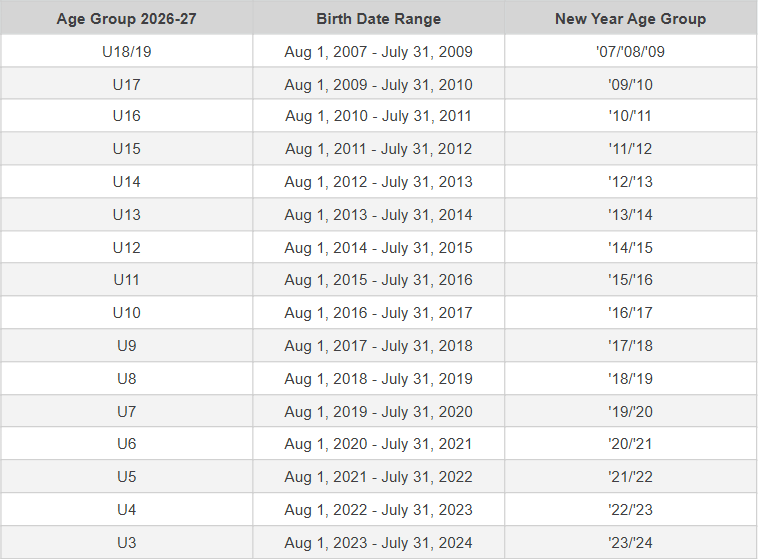
Age Group Matrix (2026–27 Season)
Use the chart below to find your child’s U-Level and Team Name.
FOURTEENTH EDITION
This is an update email about El Paso Locomotive FC x Education Corner. We have updated our contents, sharing an article that is about finding pathways for elite athletes within youth sports. It has a European setting mainly, but the information certainly adds to the discussion around the American context. I understand it is a research paper, however, it is worth to read!
Please visit our website and check out this week’s addition!
THIRTEENTH EDITION
In this edition, we are sharing an article that deals with shifting the narrative of youth sports parents into a positive direction. I really enjoyed this writing because it does approach a sensitive topic in a different way. Also, it offers some solutions to the issues that might come up in the world of youth sports.
TWELFTH EDITION
In this edition, we are sharing an article that deals with shifting the narrative of youth sports parents into a positive direction. I really enjoyed thi writing because is does approach a sensitive topic in a different way. Also, it offers sole solutions to the issues that might come up in the world of youth sports.
ELEVENTH EDITION
In this edition, we are sharing an article that deals with soccer parenting from a goalkeeper perspective through an interview with the legendary MLS goalkeeper, Jon Busch. Jon is an American professional soccer coach and former goalkeeper. Busch is currently the goalkeeping coach for USL Championship club Pittsburgh Riverhounds SC.
He is best remembered for his captivating saves, despite his shorter stature for an elite goalkeeper, and spent most of his 21-year professional playing years in Major League Soccer, appearing for the Columbus Crew, Chicago Fire and San Jose Earthquakes. Busch also represented the United States at both youth and senior level.
Arguably his best season was in 2008 when he was named MLS Goalkeeper of the Year. As of the end of the 2015 season, Busch ranks fourth in MLS history in number of shutouts.
Jon Busch – A Guide for Parenting a Youth Soccer Goalkeeper
A discussion with Jon Busch about Goalkeeping 101: from equipment like glove selection to the mental side of supporting your goalkeeper.
www.soccerparenting.com
TENTH EDITION
In this edition, we are sharing an article that deals with soccer parenting in an easy and understandable way. We believe this is increasingly important, especially in our current environment, to continue exploring ways to behave better on the sidelines as a club and as a community. Please read it and spend some time with it!
NINTH EDITION
In this edition, we are sharing a link to a webinar that is directly geared towards soccer parents in America. we believe this is something all of our families should attend as they represent the values, we believe in. Please consider signing up (it is free) and attend the webinar.
TOPICS:
1. Perspective on the important role of the soccer parent in youth soccer today
2. Key take aways from our 2023 Soccer Parent Survey results
3. Considerations for sideline behavior
4. Level headed parents, unite! How and why?
EIGHTH EDITION
In this edition, we are sharing an article that is exploring the differences between the pathways offered by USL and MLS. This is an important topic for families that would like to have a widespread idea about what is happening in our country. The transitioning moment from youth soccer to the next level (college or professional) is very a delicate period. The more we learn about this process, the better we can be advising our players.
| US/SC – Comparing USL and MLS PathwaysComparing the pros and cons of young soccer players going to USL versus playing in MLS Next Pro and MLS.www.ussoccercollective.com |
SEVENTH EDITION
In this edition, we are sharing a TEDx video titled as “Sucking the fun out of youth sports”. In the video, the presenter tries to analyze the reasons why inappropriate behavior exists in the world of youth sports. We feel, especially this past weekend, that this is an important topic, because we want to change the culture we have currently on our sidelines. We hope these topics will open some discussions and will lead to some real changes.
SIXTH EDITION
In this edition, we are sharing an article that talks about some uncomfortable elements of youth soccer in the USA. We feel this is an important topic, because we want our players to feel safe and secure in the environment, we create for them. We hope these topics will open some discussions – the same discussions we are having constantly in our staff meeting at our Academy!
FIFTH EDITION
In this edition, we are sharing a YouTube link to an interview that was produced by Modern Soccer Coach platform, one of the most followed soccer-specific multimedia platforms. The interview was with our Academy Director of El Paso Locomotive FC, Ivan Militar. The interview provided an opportunity to discuss many topics – everything El Paso and anything El Paso Locomotive FC Academy! Have a listen and enjoy!
FOURTH EDITION
In this edition, I would like to share an article that was shared in the Soccer Journal publication of United Soccer Coaches. The article explores a phenomenon that we can all experience in our daily lives dealing with children in the 21st century. All children experience difficulties handling conflicts, however, in an environment of teams and athletic organizations, conflicts are even more unavoidable. As a result, I thought this would be a great article to share with our families. Maybe there are some tips we can all use to help our children succeed in competitive environments, like our Academy.
THIRD EDITION
n this post, we wanted to raise attention to the Chime In! campaign of City of El Paso. This has been included in our weekly update emails, but we thought the Education Corner could be another way to bring attention to the topic. Below, you can read more about the Chime In! campaign.
About Chime In!
The City of El Paso has started a city-wide campaign, called “CHIME IN – Prioritizing YOUR City’s Budget”. This campaign allows residents of El Paso to vote and share their own priorities when it comes to how the city will spend our tax dollars. We thought this is a perfect opportunity for our soccer community to step up and voice their concerns when it comes to the youth soccer environment in our city.
As you all know, our Youth Soccer department, Club and Academy, is struggling to find adequate amount and quality soccer fields to rent. There are very few safe and quality field rental options in El Paso, and we are falling behind as a city by not providing acceptable training fields to our local teams, Locomotive as well as other clubs.
All these aspects can be communicated through this survey. We ask you to participate and fill out the answers portion as well, to direct the decision-makers’ attention towards youth soccer.
SECOND EDITION
This article is to provide you with all the information about tryouts, ID Camps, and the entire Player Selection Process for the 2023/2024 season, starting August 2023. Please read the following information carefully and feel free to reach out if you have questions.
As it was shared with you during our in-person Academy Meeting back in November 2022, our Player Selection Process has 3 key areas to consider. I will discuss these 3 areas in detail.
- Individual Development Planning
During the Winter of 2022-2023, all Academy coaches completed the Individual Development Planning (IDP) process with all Academy players. In this process, the coaches discussed certain details with the players when it comes to needed improvements, weaknesses, strengths, and even future implications. Some players were told that they are doing great but need to improve on certain aspects, some players were told that they are not in the top half of their team but they will most likely stay on the team for next year, and some other players were told that their current role on an Academy team is being challenged by other skilled players in our Club and the area.
In other words, during the IDP process, some players got a lot of positive feedback, and some others did not. There are no secrets in this regard: there will be players that will not have a spot on one of our Academy teams next seasons, because we want to match the skill levels appropriately on our Academy teams. That is why we did the IDP process for the first time in our Academy’s history and this is why we are motivated to continue doing these meetings, so families will not get surprised when we make certain decisions about player selections. The IDP meetings were for feedback and heads up at the same time.
Important information: any Academy player who is being released from an Academy team will have an automatic position on the same age group’s top Club team.
- Club Tryouts vs Academy ID Camps
This is a very important part of the process of placing players in our organization. Our Club teams will have tryouts, where all Club team players will participate. In these tryouts, all Club players will be placed on a team based on their skill levels. We are planning to add a lot of players through tryouts, as we are anticipating a lot of players wanting to join our Club. Tryouts for the Club will be free of charge, since we want to make sure that we are selecting from the widest possible range in our area.
On the other hand, our Academy will not have tryouts. This means, we are not deciding on player selections based on a 2-day performance on tryout days. We are going to make our player selections based on the performances of the whole year on and off the field, including commitment, attitude, and soccer performance equally. Our decisions will be based on the current Head Coach’s suggestion in addition to the entire Academy Staff’s suggestions – as we are lucky to have coaches who have spent time with other teams other than their own.
Instead of tryouts, we will continue to have ID Camp sessions. With the Academy not having tryouts, we will not invite our own players to any of our Academy ID Camp sessions. As we have already organized two ID Camp sessions for the younger age groups, I can tell you based on experience, that tn these sessions, we will have players from all over El Paso, who want to join our Academy. As we will have our next set of ID Camp sessions in May – right in the middle of tryout season, we expect that we will have a lot of participants in these sessions. These sessions will cost each player $25, which amount represents the ambition that someone shows in order to join our Academy.
Our first instinct will be to add our own Club players to the available open spots of our Academy teams. Our second instinct is to explore players of this area through the ID Camp sessions and see if we can find some potential players to add. If we find a player, we will not add that player automatically to our Academy for next year, instead we will invite them to training sessions and see how they interact with our current players. Only after this process, with the confirmation of myself and the coaches, will we make a final decision of addition.
As an Academy parent, you probably have already seen different players from different clubs show up and train with our teams. Those players are all going through the process of identification for next season.
- Timing and Commitment
We are planning to communicate our Player Selections at the end of May and in the beginning of June the latest. It is important to understand that we have a full commitment towards all our current players who are playing on our teams now, regardless of our player selections for the following season. Which means even if a player is being placed on a Club team for next year, we expect them to finish their season on our Academy team.
In general, these times are “crazy times” in the youth soccer world and as a staff we are expecting nothing less. However, we are excited to attack this process head on and make some decisions for the future. Please help us as much as you can to make this process smooth and healthy!
FIRST EDITION
In this edition, I would like to share two different contents:
1. How to College: First Gen – PODCAST
This is a podcast created by First Generation students (students that have parents who do not have received colleg education) for potential college students. I am one of those First Generation students, so I am completely aware of how difficult the application and the financial piece could be. Managing the process of getting into college could be confusing and complicated. This podcast helps students, parents, and families to receive ideas, tips, and solutions for those type of issues. I highly recommend listening to all the episodes.
2. Arsene Wegner FIFA Interview – YOUTUBE VIDEO
If you know Arsene Wenger, the legendary Arsenal head coach, you must know that he is one of the best coaches ever when it comes to developing young players and creating a style of play with his teams. In this interview he shared his thoughts on the essence of football, youth development, and had fascinating takes on the current status of world football. It is definitely worth a listen.
I hope this content will open up new perspectives and share some useful information with you all! Until next, see you guys on the fields!
IS WINNING EVERYTHING?
In preparation for what is ahead, I thought it would be beneficial for our community to read about “winning” in youth soccer. I know what you all are thinking… How can someone say winning is not important? I would like to share my own thoughts on the matter.
First of all, I am an extremely competitive person. I have always been. I was the kid that cried after a loss, I was the boy who had a father who was disappointed if I did not play well, and I was also the one who wanted to get all the individual award at every single U12 tournament…
Due to my drive, my talent, and the opportunities I have received from my coaches, parents, and teammates, I was able to become a full-scholarship Division I student-athlete at Old Dominion University. Notice that winning was not the reason why that happened. Winning is the result of my drive, my talent, and the opportunities I have received. As a result, logically, I think winning is less important that developing the players’ abilities to be motivated, skilled, and enjoy the environment they are in.
I would also like to add that learning is what drives development. And learning equals to experiences. In other words: in order to develop you must learn how to handle losses just as much as winning.
Please read the article, it is a good one.